
Empirical Knowledge in the Eighteenth-Century Novel
This Element examines the eighteenth-century novel’s contributions to empirical knowledge. Realism has been the conventional framework for treating this subject within literary studies. This Element identifies the limitations of the realism framework for addressing the question of knowledge in the eighteenth-century novel. Moving beyond the familiar focus in the study of novelistic realism on problems of perception and representation, this Element focuses instead on how the eighteenth-century novel staged problems of inductive reasoning. It argues that we should understand the novel’s contributions to empirical knowledge primarily in terms of what the novel offered as training ground for methods of reasoning, rather than what it offered in terms of formal innovations for representing knowledge. We learn from such a shift that the eighteenth-century novel was not a failed experiment in realism, or in representing things as they are, but a valuable system for reasoning and thought experiment.
 Theatre & the digital
  Hemispheric Regionalism
  Protocols of Liberty: Communication Innovation & the American Revolution
  The Reading Nation in the Romantic Period
 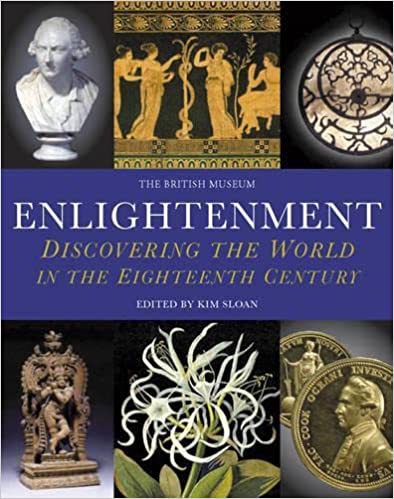 Enlightenment
 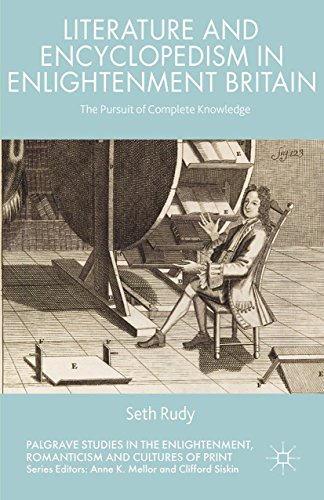 Literature and Encyclopedism in Enlightenment Britain: The Pursuit of Complete Knowledge (Palgrave Studies in the Enlightenment, Romanticism and Cultures of Print)
  Poetry and the Idea of Progress, 1760–90
  The Ends of Knowledge: Outcomes and Endpoints Across the Arts and Sciences
  Writing to the World: Letters and the Origins of Modern Print Genres
  Conceptualizing the World: An Exploration across Disciplines (Time and the World: Interdisciplinary Studies in Cultural Transformations Book 4)
  The Ends of Literary Studies